On Looking Again #3 We Don't Know So Much About Ourselves
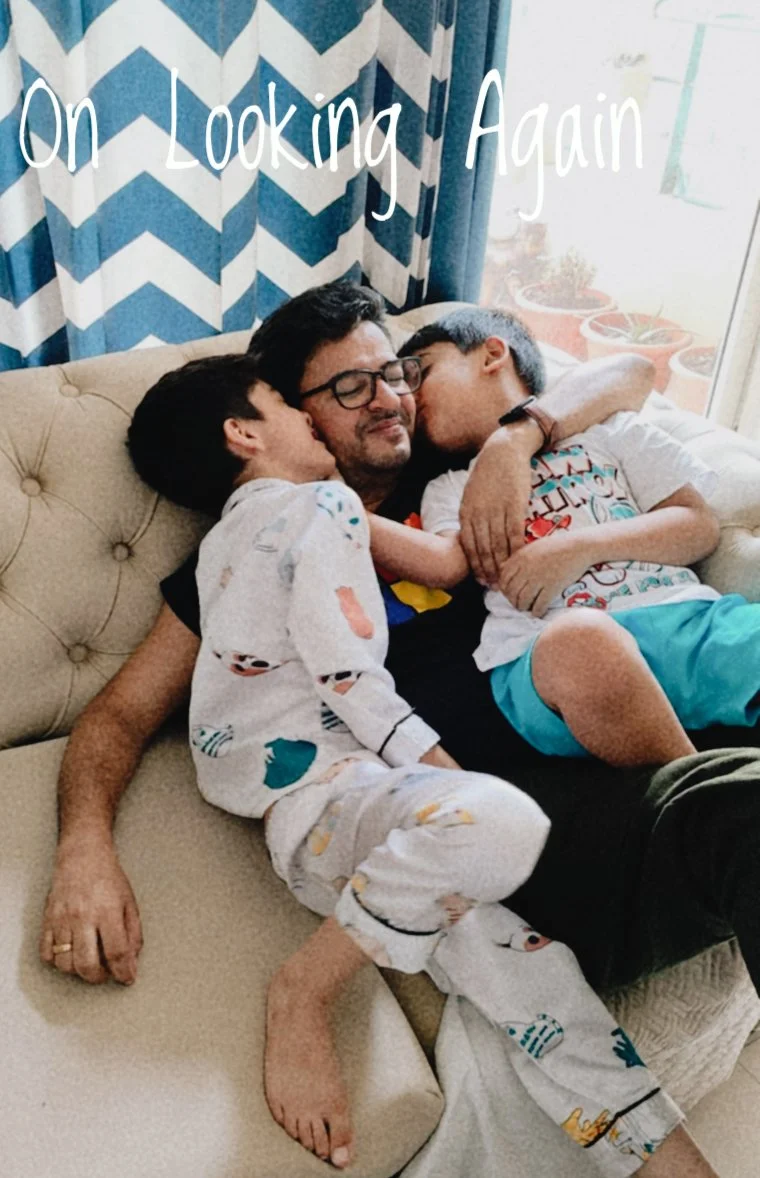
For the longest time, I thought I knew why I loved this photograph.
It was simple.
Two little boys, who are more like brothers than friends, had climbed over me on a sofa. One on either side. Neither paying any attention to the camera. Just an ordinary afternoon, interrupted for a second by Dee pressing the shutter.
I loved it because it was full of affection.
Or so I thought.
Today, looking at it again, another photograph quietly surfaced.
It has lived in my memory for decades, though I haven't seen it in just as long.
My father is sitting on a maroon sofa in the ‘drawing room’ of our government flat sometime in the eighties. My elder brother is leaning against one side of him. I am on the other. I must have been four, my arms hugging him across his tummy. Almost the same age as Adu is here. My brother, three years older than me, roughly the same age as Y.
That photograph no longer exists.
Somewhere along the way, my family's photographs disappeared. Moves, time, neglect…whatever the reason, our visual history survives only in memory now.
Except, perhaps, it doesn't.
Perhaps it survives here too.
I had always believed I loved this photograph because it captured something beautiful in the present.
It never occurred to me that I might have loved it because it was quietly reminding my heart of something it had already lost.
We don't know so much about ourselves.
We like to think we understand why a particular song makes us stop what we're doing, why a certain smell feels like home, why one photograph keeps drawing us back while a hundred others fade into the archive.
Maybe we don't.
Maybe our lives are held together by invisible threads that only reveal themselves years later, when one ordinary photograph reaches across time and takes the hand of another.
One that no longer exists anywhere except inside us.
On Looking Again #2: What the Photograph Kept
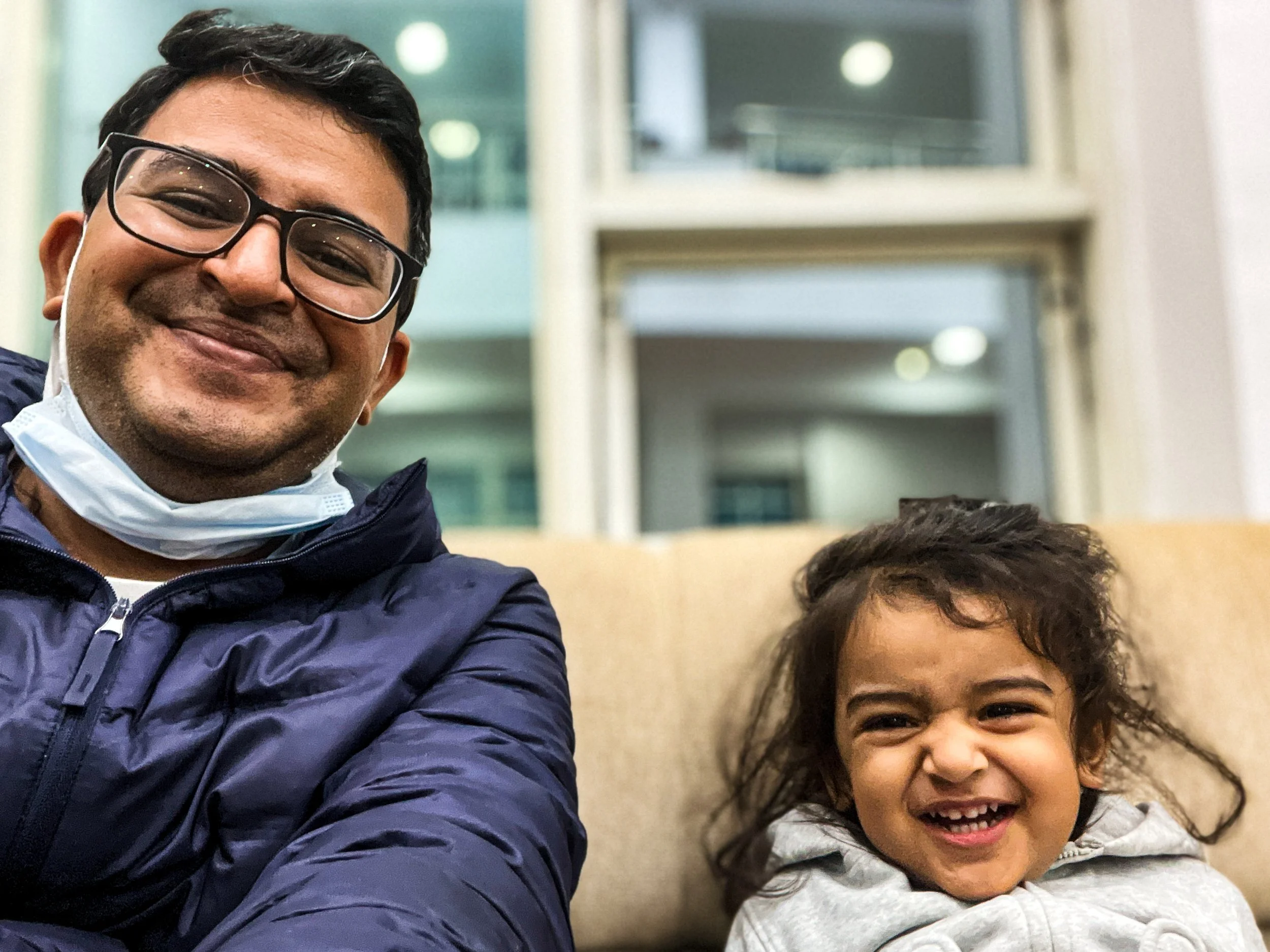
I don’t remember this moment.
Not really.
I know where we are. A guest house in Jaipur. On a trip with the extended family. December 2021. We are waiting in the reception area of a guest house for the rest of the family to come down. Dee is somewhere upstairs. We are waiting to go sightseeing.
Adu is not yet two.
That’s about all I know.
What I do have is this photograph.
For a few moments, it seems, we were the only two people in the world.
I don’t remember what made him laugh. I don’t remember what we talked about, if we talked at all. The photograph has kept none of that.
What it has kept is the smile.
The complete, reckless abandon of it.
I have looked at this photograph many times over the years. At first, I looked at him. Lately, I find myself looking at the space between us.
At the invisible thread that every parent spends years trying to strengthen and then, somehow, learning to loosen.
The photograph doesn’t know any of this, of course.
It knows nothing of school admissions, birthday parties, report cards, arguments, arrivals, departures. It knows nothing of the long work of becoming a person.
It only knows that on a winter morning in Jaipur, a little boy laughed and his father laughed back.
Perhaps that is why I keep taking photographs.
Not because they stop time.
They don’t.
But because every now and then, they return a small piece of it.
Long after the moment itself has gone where all moments go.
On Looking Again #1: What I Thought Was Missing
The photographs are better than I remember.
That’s the first thing I notice.
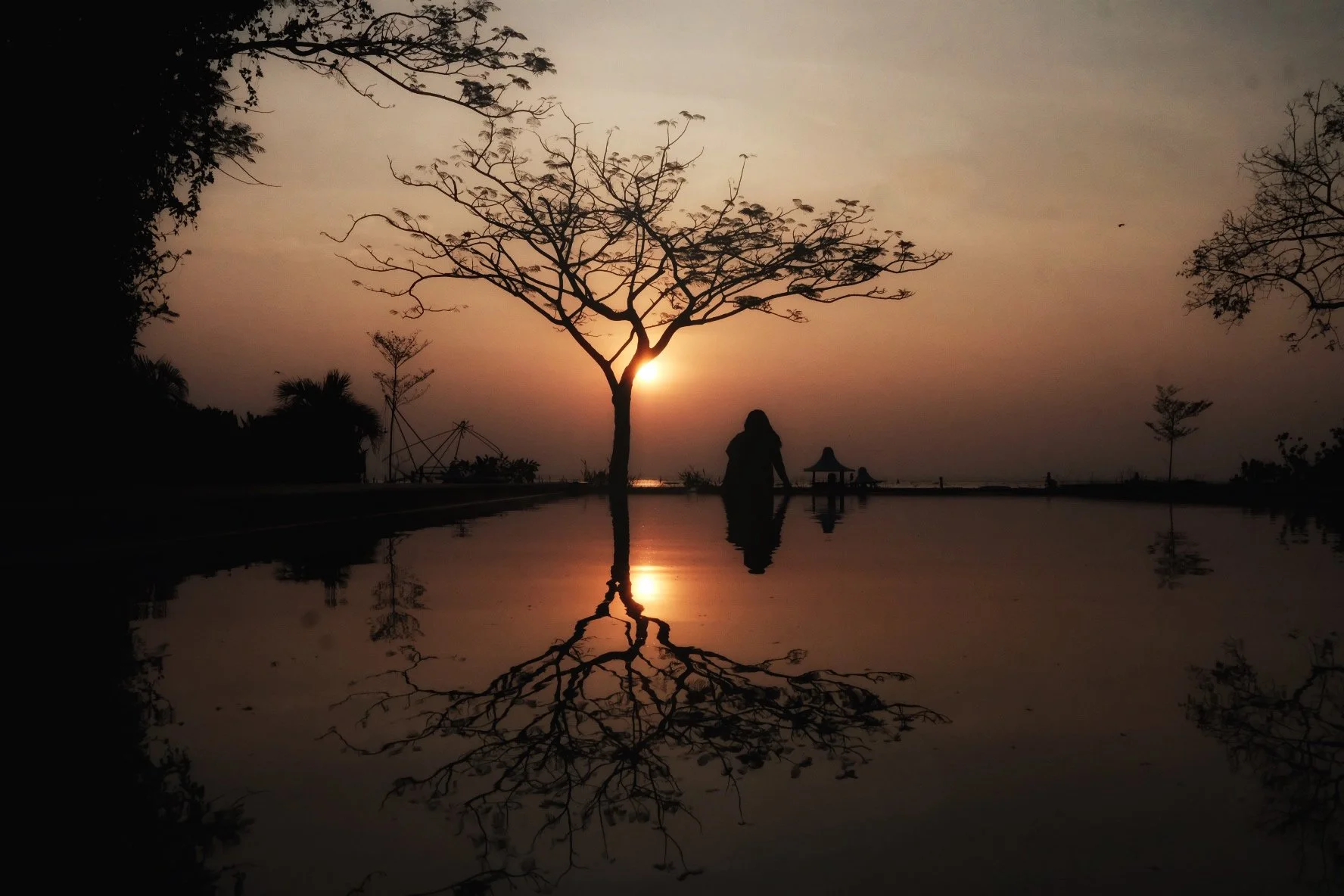
For years, I carried around the memory of being disappointed by that morning. Dee and I had slipped out of our resort room in Kerala before sunrise, leaving Adu asleep, and walked towards the pool with my camera. I must have taken a hundred photographs, but this set was special. Dee sat by the pool while the world slowly emerged from the darkness. The light arrived exactly as it was supposed to. The reflections arrived. The stillness arrived.
Out of the hundred odd photographs, I remember liking very few of them.
Looking at this picture now, I find myself wondering what exactly I thought was missing.
Memory is strange that way. It preserves the dissatisfaction and discards the evidence.
Later that day, I wandered out of the resort and into the nearby village. I met people whose language I didn’t understand and who didn’t understand mine. We smiled, pointed, managed. I found small temples unmarked on Google maps and tour itineraries, though they were no less beautiful than their more famous cousins. By the time I returned, hot, sweaty and thoroughly lost, I felt richer than I had that morning.
Looking back now, I don’t think I was disappointed with the photographs at all.
I think I was beginning to outgrow a certain way of taking them.
The camera had spent years helping me collect beautiful sights. Around this time, I had begun asking it to help me discover something.
The village walk offered that more readily than the resort ever could.
And yet, years later, it is this photograph that has brought the whole day back.
Not the temples.
Not the lanes.
Not the conversations stitched together with gestures.
This one frame.
Perhaps that’s what photographs do best.
They wait quietly for memory to catch up.
उधार की एक सुबह
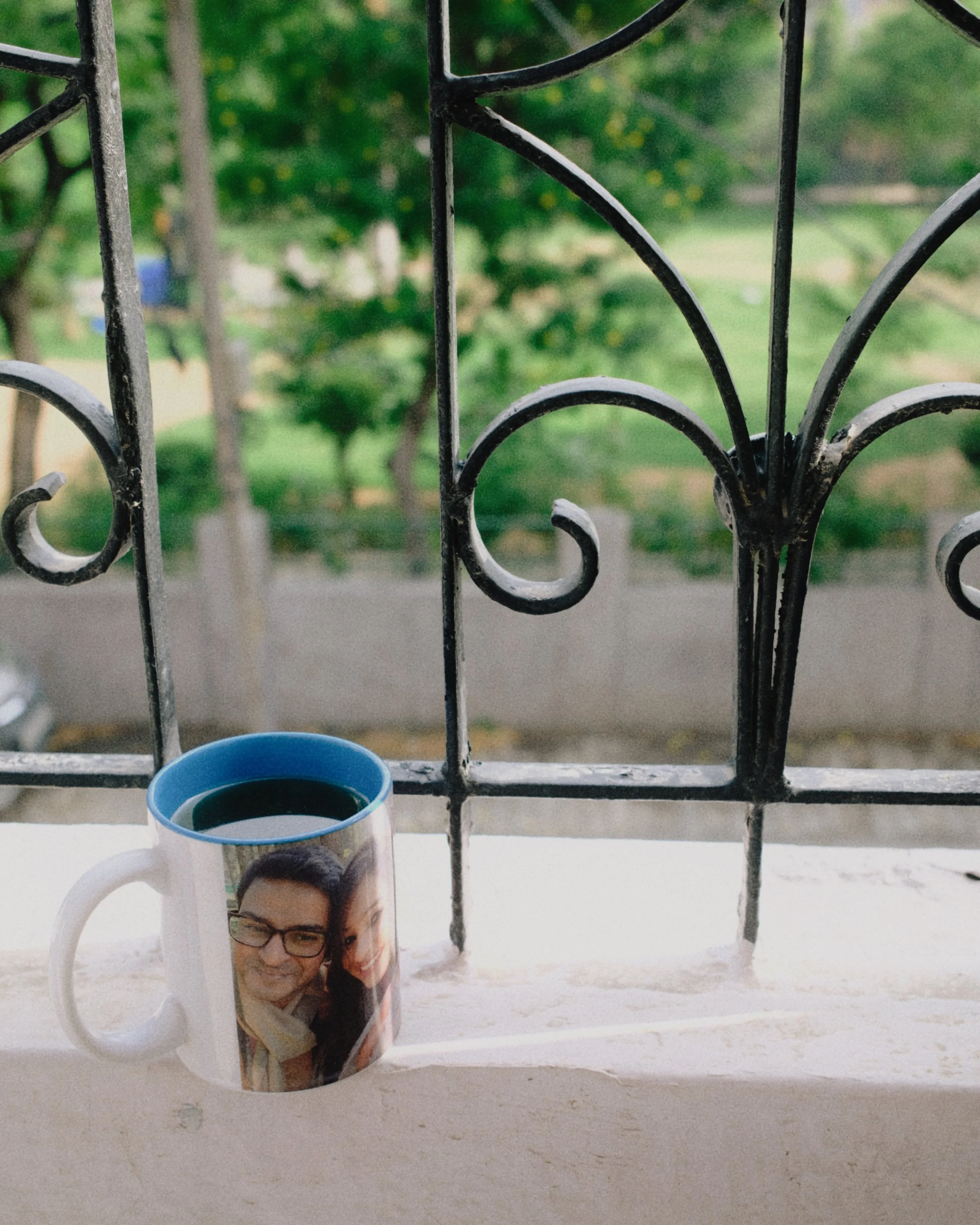
नौकरी से उधार माँगी हुई एक सुबह में, एक उधार की बालकनी पर बैठा हूँ।
कुछ ख़ास नहीं कर रहा।
थोड़ी-बहुत बातें कर रहा हूँ तुम्हारे साथ। गिलहरियों का चहचहाना सुन रहा हूँ। परिंदे भी हैं, मगर आज गिलहरियाँ ज़्यादा बातूनी निकली हैं।
कुछ ख़्वाबों को सुबह की सैर पर भेज दिया है। कुछ लौट आएँगे, कुछ शायद रास्ता भूल जाएँगे।
बीच-बीच में हम दोनों देर तक चुप भी रहते हैं। इतनी देर कि चुप्पी भी बातचीत का हिस्सा लगने लगती है।
ऐसी ही एक सुबह याद आती है। बहुत पुरानी। जब तुम्हारे साथ बैठकर बस चाय पी थी।
सोच रहा हूँ, ज़िंदगी के आख़िरी बरसों में मुझे क्या याद रहेगा? कौन-सी मीटिंग, कौन-सी फ़ाइल, कौन-सा सोमवार?
या फिर ऐसी कोई सुबह।
एक उधार की बालकनी। बारिश से धुली-धुली सी धूप। गिलहरियों की आवाज़। और तुम्हारा साथ।
तुम्हारे साथ बिताई हुई कुछ सुबहें अंटी में खोंस के रखने का मन करता है।
ज़िंदगी की शाम में बैठकर उन्हें खर्च करने का इरादा है।
Writing the memoir while living it
Lately, I've been wondering why I love memoirs so much.
Not biographies. Not even autobiographies, most of the time. Memoirs.
The kind that arrive in fragments. A childhood memory. A family story. An afternoon that seemed ordinary until it wasn't. Nothing particularly consequential happening in the larger scheme of history, yet by the last page you feel as though you have travelled a great distance. You have accompanied someone through a life. Someone you never met and never will.
Looking back, I think I was reading memoirs long before I knew the word existed.
One of my favourite books as a 10-12 year old child was a thick collected works volume (knows as a Samagra in Hindi) by Shri Rameshwar Tantia, published by a small press in Varanasi that seems to have disappeared now. My father introduced me to a lot of Indian literature through this press, they specialised in printing collected works of legendary Indian authors in dense typesetting to reduce the overall cost. Will talk about it some other time. This samagra contained what I believe all of his works. I remember reading his account of Indian history, but what stayed with me most was his recollection of life…from growing up in rural Rajasthan before Independence to becoming a freedom fighter and eventually a member of parliament under Nehru. For reasons I couldn't have explained then, I read the story of one man's childhood with the same fascination as the story of an entire nation.
Years later came Orhan Pamuk. First Snow, then Istanbul in quick succession. I remember feeling something close to what Eklavya must have felt towards Dronacharya. Without his knowledge or consent, I had found myself a literary guru. Even today, I wish I could write about my younger self and the Delhi of those years with the same tenderness and precision with which Pamuk wrote about Istanbul.
More recently there has been Ann Patchett's These Precious Days. Have written about it [here]. Currently reading Patti Smith's Just Kids, whose opening chapter is among the more devastatingly beautiful pages I’ve read in recent times. Also started Janet Malcolm's Still Pictures a couple of days back. At first, Malcolm puzzled me. Her memoir pieces seemed to wander off without arriving anywhere. No interconnectedness, no grand insight, even no formal ending. But slowly I've begun to appreciate that quality. Perhaps lives themselves are more like that than we care to admit.
I don't know why memoirs call to me.
Perhaps, second only to science fiction, they are my favourite form because they are both trying to answer the same question from opposite directions. One asks what it means to be human by imagining other worlds. The other asks the same question by looking closely at this one.
Or perhaps it is something simpler.
I've always been interested in the meaning hidden inside a life. Why certain people arrive. Why certain years change us. Why some memories remain luminous while others disappear entirely. Memoirs feel like conversations with people who have spent years asking those same questions.
And maybe there is one more possibility.
Perhaps I love memoirs because, somewhere in the back of my mind, I am already building one.
Not on paper. Not yet.
But in the way I pay attention to a song that arrives at the right moment. A conversation over tea. A hospital waiting room. A walk. A city. A season.
As though life is being lived once, but remembered simultaneously.
As though I am writing the memoir while the story is still happening.
Waiting Room, Planet Earth
11:18 AM.
Waiting for my turn with the doctor. Sitting in the lounge area at the Hospital.
(My Funny Valentine, Chet Baker) “Your looks are laughable, unphotographable, Yet you’re my favorite work of art…”
Reading the introduction to The Book of Disquiet on Kindle. Listening to my favourite songs playlist on my headphones. Looking around.
(We Have All the Time in the World, Louis Armstrong)
“We have all the time in the world, Time enough for life , To unfold…”
A lady on my left is on a video call with an old person. Or maybe with someone holding the phone for them. The old person is the patient. Oxygen mask. Tubes. All kinds of hospital paraphernalia. Then the camera moves and shows the rest of the room. Relatives sitting around with that peculiar silence hospitals produce. The kind where nobody knows what to say anymore but nobody wants to leave either.
On my right, a man scrolls through his recent calls.
(Aanewala Pal, Kishore Kumar)
“हो सके तो इसमें ज़िंदगी बिता दो, पल जो ये जानेवाला है…”
The first name is ‘Mullah Ji.’ The rest are Hindu names. I start wondering if the Mulla ji is this person’s godman of some sorts. Then he opens WhatsApp. Endless religious greetings. Folded hands. Flowers. Gods arriving every morning as forwarded messages.
(The Golden Boy, Parov Stelar)
“I’ve got this feeling inside my bones…”
There are people of all ages here. Most look anxious, tired, pensive. Some seem on the verge of crying. Children alone appear untouched by the atmosphere. They are laughing, running around, asking for chips and cold drinks. They don’t know yet what life eventually becomes.
(Cry Me a River, Dinah Washington)
“Now you say you’re lonely, You cried the long night through…”
Perhaps that’s why childhood matters so much. It may really be the only phase of life where we are protected from the knowledge of what awaits us later. Hospitals. Reports. Medicines. Parents growing old. Our own bodies quietly beginning to betray us.
(Up – Solo Piano Theme)
There are no lyrics here. Only that strange ache the piano carries. The feeling of remembering something while it is still happening.
An old lady sits beside me gingerly, as if sitting down is only slightly less painful than getting up will be. After a while, a man, her son, I assume, comes and holds her hand while helping her stand.
(Look at the Sky, Osman)
“Look at the sky, I’m still here…”
How much of life changes in this simple holding of hands.
She must have done this for him once. Crossing roads. Getting off buses. Walking through markets. Holding his tiny fingers through fevers and fairs and childhood fears. And now life has quietly reversed the whole thing.
I look around at old people who must have once been strikingly handsome or beautiful in their youth. People who must have once looked into mirrors with confidence. Strange how time slowly removes everything we once thought was permanent.
(We Are Nowhere, Bright Eyes)
“We are nowhere and it’s now…”
Then I see a young woman walking across the lounge with an older woman, perhaps her masi, and a younger girl who looked like her sister. She was so beautiful that I couldn’t stop looking at her. Not glamorous-beautiful. Something quieter. Almost painful to look at. Like one of those statues of Mother Mary you see in old churches, except alive. Her eyes looked washed clean. As if life had already rinsed away whatever innocence usually remains at that age.
And yet there was acceptance on her face too. A kind of exhausted peace.
(Primavera, Ludovico Einaudi)
Again no lyrics. Just that flowing piano making the whole lounge suddenly feel like one continuous human tide. People entering. Leaving. Waiting. Hoping.
And I wonder, is there any meaning to all this movement?
All these people gathered inside a building full of corridors and machines where perhaps, years ago, there were only fields and trees.
People trying to save lives.
Trying to return to the lives they had before illness interrupted them.
Trying to welcome new life into the world too.
Sometimes it feels like this hospital lounge is just a smaller version of earth itself.
And I can’t tell anymore whether I am part of this scene or merely observing it. Whether I’m an alien or an Earthling.
Perhaps both.
Perhaps someone else sitting here is also typing something into their phone notebook right now:
Saw a man today. Middle-aged, but young in mannerisms. Wearing headphones. Typing feverishly on his phone. Must be messaging someone.
(In My Life, The Beatles)
“Though I know I’ll never lose affection. For people and things that went before…”
11:48 AM.
Just One Last Photo, Guys
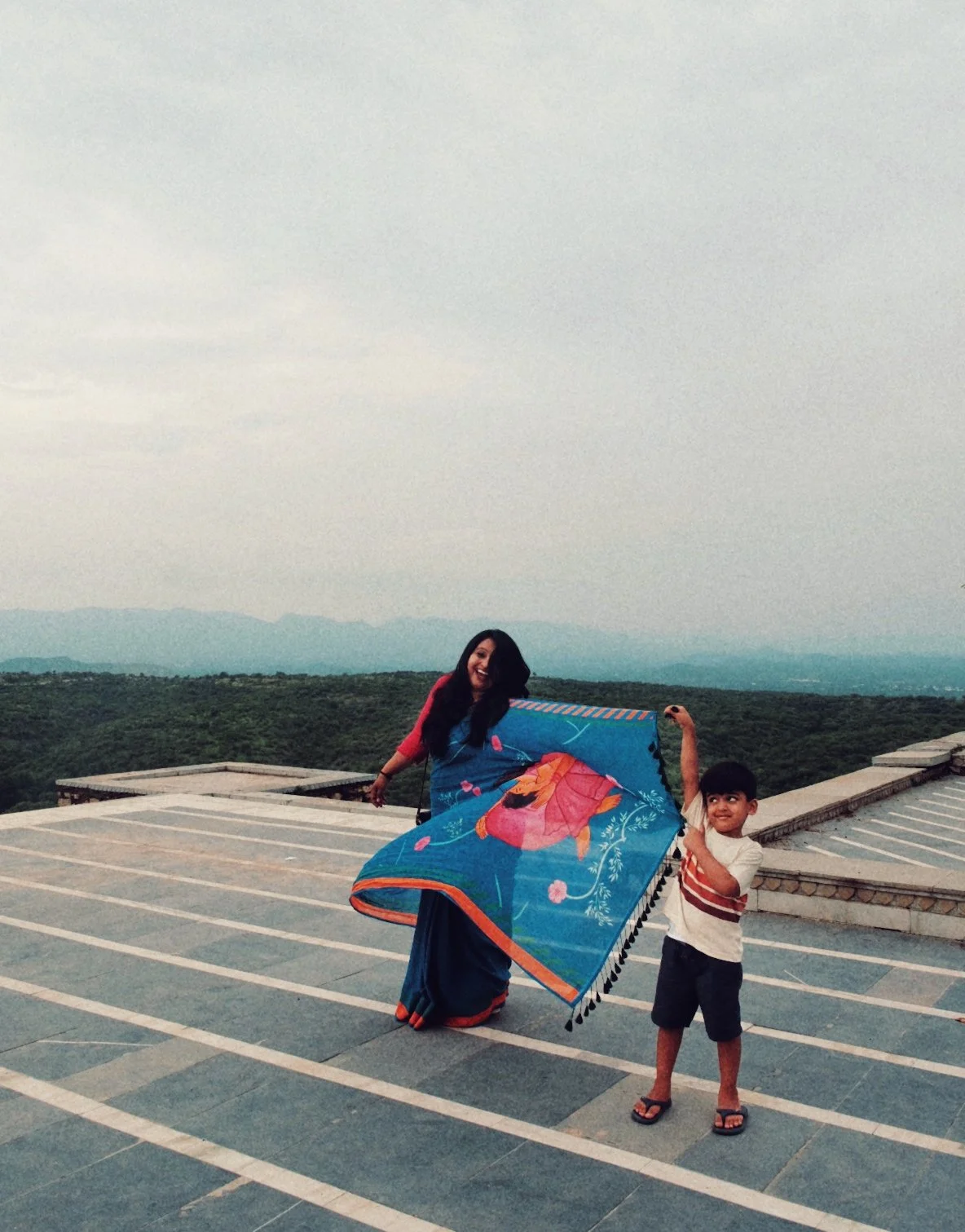
Dear Adwitiya,
Some people take photographs to remember moments.
Your mother creates moments so photographs can happen.
Which is why the two of us have spent a significant part of our lives standing behind cameras hearing things like:
“No no, candid.”
“Wait, my hair.”
“Just one last photo,” a sentence all three of us now know means at least a dozen more.
Somewhere along the way, Papa’s long-running job as Mumma’s photographer became a team project.
One of us clicks the pictures.
The other holds Mumma’s saree dramatically against the wind and offers highly questionable creative direction.
And honestly, some of my happiest memories now look exactly like this: pretending to be irritated while secretly loving that she wants to freeze ordinary moments into something worth keeping.
So yeah, let’s wish a very happy Mother’s Day to the heart of our little team.
Love,
Your senior partner in Mom’s photography crew.
Repaying the Debt of Smiles Past

Some mornings feel like a quiet accounting of the life we have lived.
This morning, before the world had properly woken up, I was lying beside my son, running my fingers through his hair. The slow, careful way you touch a sleeping child when you don’t want the spell to break. He has been on medication, breathing unevenly the way children do when the weather turns against them. Another allergy. Another small battle his body is fighting.
A kilometre and a half away, in a hospital room full of loud white light, my wife is fighting pneumonia.
Life has a way of arranging these scenes without asking us first.
…
The mind, when it is worried, rarely stays in the present. It travels. Mine travelled back to the second Covid wave. Those long forty-odd days when my wife was in the hospital and I existed between phone calls, oxygen numbers, and the stubborn hope that she would come home. There were nights when I truly did not know if she would.
And yet she did.
Life returned to its ordinary rhythms. Work. School mornings. Telling each other the strange dreams we had seen the night before. The small arguments that belong only to people who share a life.
…
I turned forty-six earlier this year. Somewhere along the way I have realised something about happiness. And about sadness.
Happiness has always arrived for me slightly tinged with sadness. Even in its brightest moments there is a faint awareness that this too is passing. That the laughter, the sunlight, the quiet warmth of someone I love sitting beside me — all of it will someday dissolve.
Sadness, on the other hand, is pure. It does not pretend permanence. It simply arrives, sits beside me for a while, and slowly merges into me.
Perhaps that is why I try to hold small, insignificant moments a little longer than they deserve.
Long before social media arrived, I used to send SMS messages to friends telling them what I was doing in that moment and asking the same in return. A tiny status update on life.
Maybe that is why I was drawn to writing and image-making, to capture something that will never come back again.
The calm of dust motes floating in a stream of sunlight.
The quiet immensity of a sleeping child’s heart under my palm.
My wife’s voice on the phone saying she is feeling slightly better. Weak, but better.
…
We never really know what is around the corner.
And yet we live as if we do.
We make plans for next summer. We postpone joy for calmer days. We tell ourselves that life will eventually settle into something predictable.
There are lines from a Gulzar song I often return to:
Muskuraoon kabhi, toh lagta hai, jaise hothon pe karz rakha hai. (Whenever I smile, it feels as though a debt has been placed upon my lips.)
I thought I understood it. But some mornings are a refresher course in meaning.
Life has collected its dues before. It probably will again. That seems to be part of the arrangement.
But still, when my son sleeps beside me in the quiet morning, and my wife is fighting her way back to health in that hospital room a kilometre and a half away, I find myself doing the only thing I know how to do.
Living.
Holding the small sharp shards of joy carefully in my hands.
Smiling a little.
Even if life is keeping count.
The Summers We Carry
“Try to remember it always,” he said once Gogol had reached him, leading him slowly back across the breakwater, to where his mother and Sonia stood waiting. “Remember that you and I made this journey together to a place where there was nowhere left to go.”
― Jhumpa Lahiri, The Namesake

It is perhaps my favourite moment from the book—and the film. A father hoping his son will remember. A quiet plea for permanence in a world that forgets too quickly. This summer, I carried that plea quietly in my heart.
Now five years of grand old age, this was perhaps the first summer vacation my son will remember—at least in flashes, in colours, in movement. So I tried to make it worthwhile. All the while, comparing it, inevitably, to the ones I had.
The calendar turned to May, and I felt it again: that inner leap. A reflex from a childhood long folded into memory. Nearly four decades ago, my summer vacations began with a tidy sprint through vacation homework, so the rest could sprawl loose and lovely. Days unmarked by routine, filled with reading marathons and long hours of daydreaming in the corners of our big, colonial-era home. Yes, there were toy cars, action figures, and books—but my truest companion was boredom, and the imaginary worlds it opened. I disappeared into them as only a child can.
Now, I watch my son run into his own summer, and the excitement is just as fierce, though it burns differently. His days are driven by motion. His dinosaurs rule the living areas, his toy cars zigzag under furniture, and he barrels through his world with a joy so physical it nearly hums. Books are companions, yes—but the dino roar always wins. I don’t mind. It’s his summer, not a replica of mine.
Back then, we didn’t take many pictures. My summers are stored in smells and sounds: the taste of phalsa and jamun, the creak of a ceiling fan, the murmur of Doordarshan in the background. His summers, though, are being chronicled—clips, clicks, snippets of now—for a someday when he may need to remember.
And when he does, I hope he finds me there. Not as a blur in the background, but fully present. Creating imaginary Jurassic Parks with him. Going out on evening walks. Movie nights, vacation trips, adventure stories of Adwitiya and Crexy. Bathing, singing, listening, photographing—or if nothing else, just sitting still. Sometimes just watching, just being.
This summer has passed in a blur. And now, as the days begin to fold back into structure, I can only hope I was there enough. That I was part of his summer the way he was once the centre of mine.
झोले में बारिश
झोला साथ लिए चलता हूँ
झोले में बूँदें हैं
बूँदों में बारिश है
बारिश में यादें हैं
यादों में पानी है
पानी है या आँसू हैं
झोला है या आँखें हैं
साथ लिए चलता हूँ बस
थोड़ी बारिश झोले में
-आलोक,
०३ जुलाई, २०२५
A story made of fire and time
Review: Portrait of a Lady on Fire
(Dir. Céline Sciamma, 2019)

Image sourced from Pinterest
There are movies that you watch. Then there are movies that you listen to so intently, they become memory itself. Portrait of a Lady on Fire belongs to this second kind—it doesn’t unfold so much as it smolders, waiting patiently for you to lean in, to let it burn you, quietly, irrevocably.
I didn’t see it in one go. I saw it in intervals—fifteen minutes between meetings, ten before a call, twenty after a long day’s work. But even in this fragmented watching, the film never lost its hold on me. Every time I returned, it picked up as if no time had passed, its intensity preserved in the embers. Most films suffer from such disruptions. This one adapted to them—perhaps because it, too, is about longing suspended in time, about love stretched and stilled like a moment inside a painting.
Céline Sciamma crafts the film like a living canvas. Every frame feels hand-mixed—shades of honey, salt air, and earth. There is a liquidity to the way it moves, like brushstrokes finding form. The composition is meticulous: warm candlelight bleeding into cool stone, the sea flickering like a restless conscience. Sciamma doesn’t simply create mise-en-scène; she paints with it.
The absence of a traditional score only deepens this immersion. The film chooses silence over sentimentality. The everyday becomes the orchestra—fabric swishing, footsteps echoing, waves humming against the cliffs. And most vividly, the sound of fire. It crackles through the film like a pulse—domestic, dangerous, intimate. It’s not a symbol but a presence. The fire becomes the film’s emotional metronome, marking the rhythm of restraint and release, of things that will ignite but cannot last.
The story is both simple and labyrinthine. Marianne (Noémie Merlant), a young painter in late 18th-century France, is commissioned to paint Héloïse (Adèle Haenel), who is to be married off against her will. Héloïse had refused to sit for a previous portrait, so Marianne is brought in under the guise of companionship—to walk with her, observe her, and paint her in secret. But as Marianne looks, she begins to see. And in being watched, Héloïse begins to awaken. What begins as study becomes conspiracy, becomes connection, becomes love.
Love, in this film, is an act of looking. But it’s not passive. It is active, equal, transformative. The gaze is returned. The lovers don’t just fall into each other—they rise into awareness of being seen. Their intimacy is wordless and slow, as if drawn by candlelight. Their bodies speak like poetry—measured, breathless, reverent.
The film gives them this brief paradise: a week without men, without judgment, without consequence. Sophie, the young maid (Luàna Bajrami), anchors the world with her quiet presence, her own secret rebellion unfolding alongside theirs. In this all-woman world, rituals emerge—painting, reading, abortion, music, sex. There is freedom, but also the shadow of return, of inevitability.
And then, there is myth. The Orpheus and Eurydice reference arrives not just as a story but as a prophecy. When Marianne turns back to look—when love, momentarily eternal, is interrupted by memory, by choice, by fear—we sense the fall. The lovers descend from their fiery perch into the underworld of routine, roles, and absence. But the gaze endures. Héloïse appears later, in a wedding dress, in a painting, in a memory, in music. She becomes the ghost that love leaves behind.
The film’s final act is quiet devastation. Marianne sees Héloïse again—only from a distance, in a concert hall. Vivaldi’s “Summer” floods in. The camera stays on Héloïse’s face, trembling under the weight of everything remembered. We don’t see Marianne. We only see the one who carries her.

Image sourced from Pinterest
“Do all lovers feel they are inventing something?”
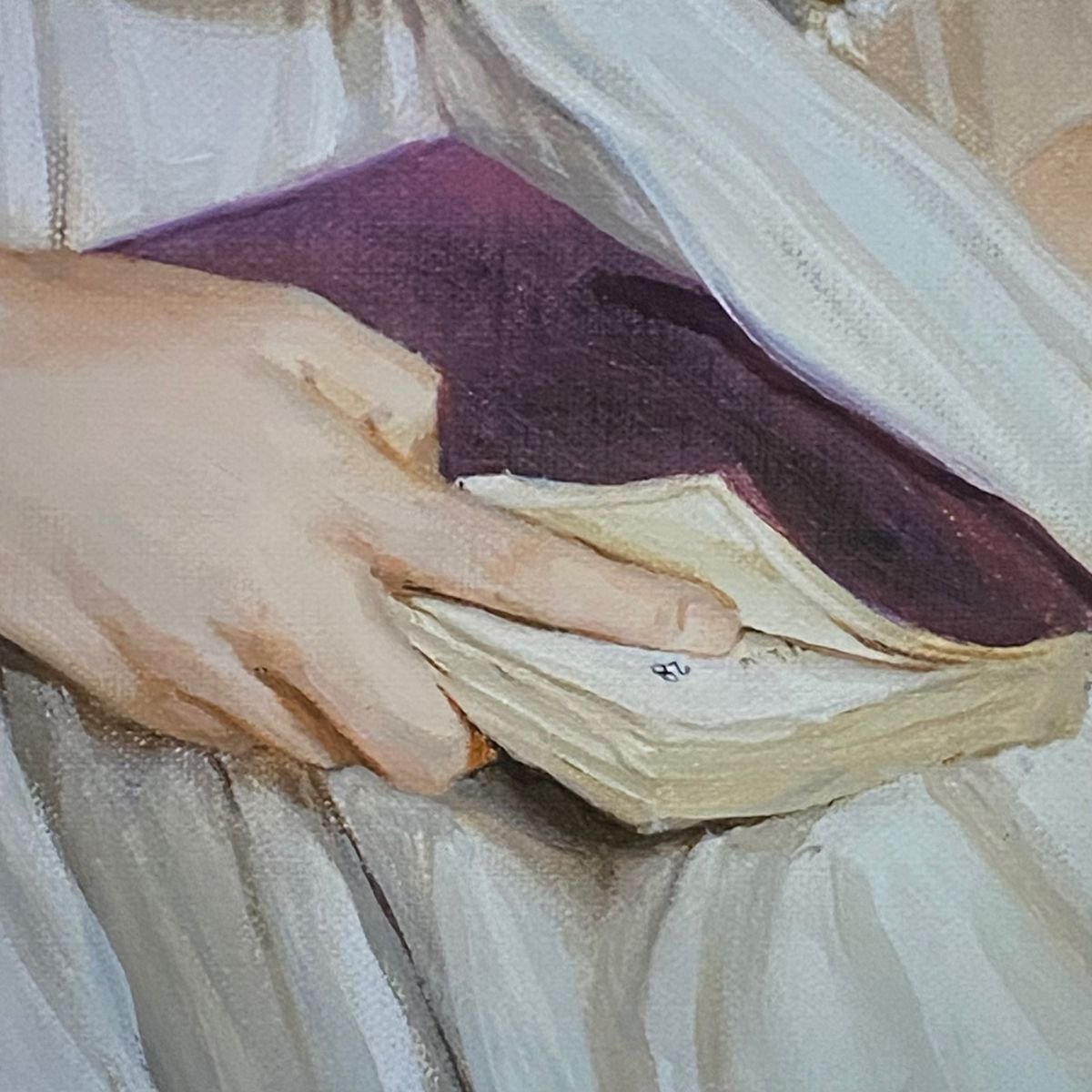
Image sourced from Pinterest
Verdict:
A masterpiece of restrained passion and visual poetry, Portrait of a Lady on Fire burns with the quiet fire of recognition. A gaze held too long, a moment prolonged beyond time, a story remembered as flame. I watched it in pieces—but it has stayed with me whole.
Between the last page and the first
Of Endings, Beginnings, and the Impossible Task of Choosing What to Read Next
If you think finishing a book is difficult, wait till you reach the real challenge — choosing the next one. That, dear reader, is where the madness begins.
You close the last page with a sigh (or a sob, or a smug “I saw that twist coming”), and then it hits you. What now? Which book deserves the honour of being next? It’s a bit like speed dating with a thousand suitors — charming, mysterious, some with suspicious blurbs, others flaunting awards like badges, and a few that just feel… right. But are they?
First, the genre conundrum. Do you stick to your memoir streak, or have you already lived too much inside other people’s heads? Maybe it’s time for something lighter. Fiction? But what kind of fiction? And won’t that also involve living inside someone else’s head — some author’s imaginary creation’s head, to be precise? Maybe you could try that romance novel you started last year but found too sweet. Real life is anything but.
Non-fiction? What kind? Historical? Management? Self-improvement? Do you really want to be a better human today? Poetry helps. But you don’t read poetry books in one go, like a novel. Back to prose. Maybe science fiction will do the trick, as it so often does. But your brain is still tired from counting the number of species in the last one.
Next comes the author debate. Do you go with the tried-and-tested writer who’s never let you down — literary comfort food, if you will — or gamble on someone new who might just become your next obsession (or regret)?
Then there’s the internet trap. Reviews! Endless reviews. “Unputdownable,” says one. “Couldn’t get past chapter two,” says another. Some people rate books based on font size; others on how “relatable” the author’s mugshot is. Your head spins.
And then — shelf guilt. Remember that pile of unread books staring at you like neglected pets? You should probably pick from there. But what about that new one everyone’s talking about? Should you read it now and ride the hype wave, or wait until it’s less mainstream and therefore more you?
I’ve been going through all of this for the past week. Ever since I finished ‘Whereabouts’ by Ms. Lahiri, I’ve been at sea. I’ve spent hours sampling many works of prose — from all the categories mentioned above and more. Yes, add to that an obscure book of scholarly art essays and a now-French woman advising how to live joyfully like a Parisian. I’ve been tempted by many, but haven’t committed to any.
As of now, I’ve started two books. One is Reading Lolita in Tehran by Azar Nafisi and the other is Fer-de-Lance by Rex Stout. The former is “a moving, passionate testament to the power of books, the magic of words, and the search for beauty in life’s darkest moments,” while the latter is the first in a series by a 20th-century American grandmaster of detective fiction. To be honest, I’m not sure I’ll finish either.
I might go back to one of the umpteen books I previously started but didn’t finish. Intermezzo, Conversations with Friends, Outline, News of the World — among the fiction works I left mid-way. The first three were very good, and I’ve been saving them for a rainy day. The last one was a used copy, and I grew suspicious of it triggering an allergic reaction. Who knows what strange microorganisms it may be carrying? (Covid cases are also on the rise again!)
There are a few non-fiction books I’d begun too — most notably Mountains of the Mind and The Half Known Life. Then there are the two photography books I ordered online, currently en route as I write. I’m also tempted to buy ‘M Train’ to continue the memoir or memoir-adjacent streak (Lighthousekeeping, These Precious Days, Whereabouts) I’ve been riding lately.
Cue a non-verbal expression of numb exasperation that others may simply call a sigh.
Let’s face it — choosing is hard. Tomorrow is Monday, and I may end up Kindle-sampling or reading one of those Amazon Originals (short stories) rather than committing to a full-length read before the workweek swallows me whole.
So yeah, here’s to all the indecisive, overthinking, passionately picky readers out there. May your next read find you — before you drive yourself gently mad trying to choose it.
What We Hold On To: Reflections on Ann Patchett’s Tender Essays
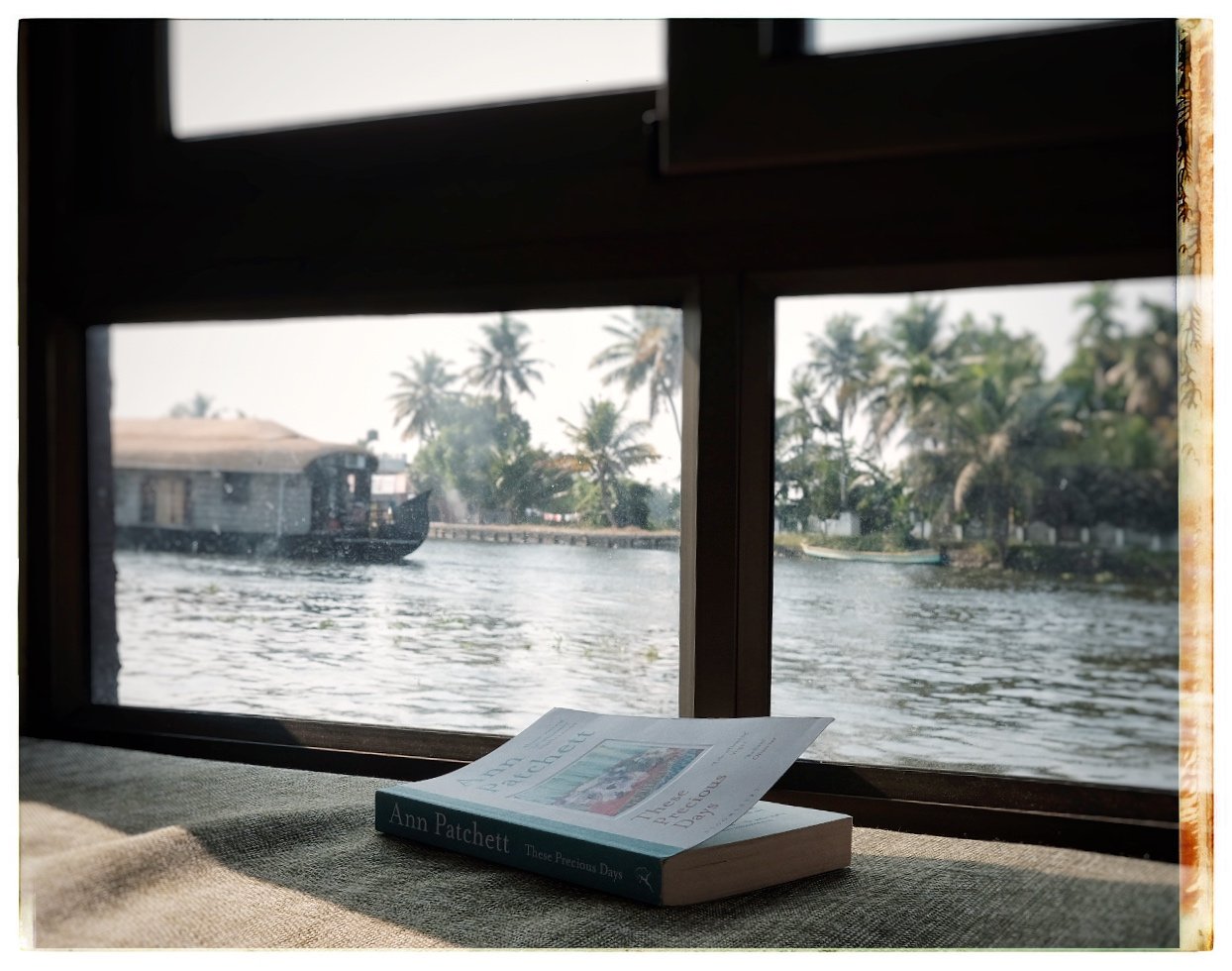
Some books arrive like gentle rain on parched soil—unexpected, slow, and quietly transformative. These Precious Days by Ann Patchett is one such companion.
I first opened it in February 2024, with the essay My Three Fathers, somewhere between the calm backwaters of Alleppey and the larger silence of being away. I didn’t know then that I’d carry this book with me for months, unwilling to let it go—like a letter from a friend I wasn’t ready to reply to.
Patchett writes not to impress, but to connect. Her essays shimmer with grace—on writing, on friendship, on choosing not to have children, on her unexpected and life-altering friendship with Sooki Raphael (Tom Hanks’ assistant and a bright, beloved presence). But it isn’t just the content—it’s the feeling these pieces evoke. Like warm light on a cold morning, or the steady voice of someone who has lived long enough to know how brief it all is, and kind enough to share what she’s learned without pretense.
This wasn’t a book I raced through. I kept it by my side, dipping in and out, holding on to it because I didn’t want it to end. There’s a certain kind of sadness when you close a book that made you feel understood—These Precious Days was one of those rare reads.
And I know, without doubt, that I’ll return to it. When the world feels noisy or thin, when I crave something tender and true, this will be the book I reach for. Again and again.
It’s become, quietly and certainly, one of my favourite reads in recent years. Not because it dazzled, but because it stayed. Because it asked, gently: what do we hold on to in this life? And then answered—with stories that remind us the answer is often: each other.
When Silence Speaks: The Haunting Beauty of Small Things Like These
Some books whisper. They do not demand attention but settle into the corners of your mind, leaving behind a quiet ache. Claire Keegan’s Small Things Like These is one such novel—a slender, unassuming book that carries the weight of a lifetime within its pages. It is the kind of story that does not shout for your love but earns it through the honesty of its prose, the stillness of its setting, and the depth of its moral questions.
Set in a small Irish town during the weeks leading up to Christmas in 1985, the novel follows Bill Furlong, a coal and timber merchant who has built a modest life for himself, shaped by the kindness of strangers and the silent burdens of his past. As he makes his deliveries, he stumbles upon something unsettling at the local convent—a discovery that stirs something deep within him, forcing him to confront the quiet complicity of the town and, more painfully, his own conscience.
Keegan’s prose is like winter light—spare yet illuminating, gentle yet unflinching. She does not waste words, and yet every sentence carries the weight of a life lived. There is an exquisite tenderness in the way she captures the mundane details of Bill’s days: the cold mornings, the familiar rhythm of labor, the small gestures of love exchanged between him and his wife and daughters. These moments are rendered with such care that they feel sacred, reminding us that the measure of a man’s life is often found in the smallest things.
But beneath this quiet beauty lies a deeper reckoning. The novel subtly confronts the dark stain of the Magdalene Laundries—institutions that imprisoned and exploited women under the guise of morality. Bill’s discovery forces him to navigate the dangerous space between knowledge and action, between what is easy and what is right. And as a reader, you feel his struggle intimately. How often do we turn away from injustice, convincing ourselves that we are powerless? How often do we choose comfort over courage?
What makes Small Things Like These extraordinary is its restraint. Keegan does not moralize; she does not need to. The weight of silence, of things left unsaid, speaks louder than any grand speech could. And yet, in the end, there is something profoundly hopeful about the novel—an insistence that even in the smallest of acts, there is grace, there is resistance, there is redemption.
Finished in one flight between Bengaluru and Delhi yesterday, I closed this slim book with a lump in my throat, aware that it had left an imprint on me. Not in the way of an earthquake, but like the slow, persistent pressure of a hand on your wrist, urging you to look closer, to care more, to be better.
Some books whisper, but their echoes last forever. Small Things Like These is one of them.
The Diaries I Read, The Diaries I Fail to Keep
There is something irresistibly intimate about reading someone else’s diary. Not in the way of trespassing, but in the way of invitation—when a writer decides their private musings should be held up to the light, when their once-secret thoughts are allowed to breathe in the minds of strangers…the literary equivalent of Big Boss for us reader type folks. I have always loved these glimpses into other people’s inner worlds, into other eras, completely different universes than mine. And yet, how similar they tend to be.
And yet, despite my admiration for the practice, I have never succeeded in keeping a diary of my own.
It’s not for lack of trying. Over the years, I have started more journals than I can count. Leather-bound notebooks, those ‘yearly diaries from random companies’ that some office goer in the family would get as a new year gift, digital attempts like Day One, or private MS Word files. I have tried the methodical approach—setting reminders, giving myself prompts. I have tried the freeform approach—letting my thoughts spill without order. Each time, I begin with enthusiasm, only to trail off within weeks, sometimes days.
Why?
Part of me wonders if it’s because I overthink the act of recording. Reading published diaries is effortless; writing my own feels self-conscious. When I sit down with a pen or at a keyboard, an odd paralysis sets in. Who am I writing to? My future self? A hypothetical reader? Should I be brutally honest or narrate with the awareness that someone might one day read this? I’m not famous enough that years from now, readers would be interested in what I was thinking that particular day. The moment I start curating my thoughts, the diary ceases to be a diary and becomes something else—an edited version of myself, a performance.
Then there’s the problem of consistency. Real diarists, the ones whose journals I love, write through everything: the thrilling days, the boring days, the days when nothing happens. I, on the other hand, feel compelled to wait for something worthy of being recorded. I tell myself I’ll write later, when I have a more cohesive thought, when I have something profound to say. But life doesn’t wait for profundity. Life accumulates in the small, forgettable moments, and if you don’t catch them as they come, they slip away.
Perhaps that’s why I admire diarists so much—because they succeed where I fail. They capture time as it is lived, in real-time, without the burden of hindsight. They remind me that there is value in recording the unfinished, the fragmented, the uncertain. That life is not just a collection of significant events but also of mornings spent making tea, of half-remembered dreams, of lists of books to read and thoughts that never quite find a conclusion.
I still want to be the kind of person who keeps a diary. I still want to look back years from now and find a record of who I was, in all my contradictions and unfinished sentences. These days, I’m trying again, knowing full well I might fail. But maybe failure itself is part of the practice. Maybe the act of starting a diary—again and again—is its own kind of diary.
Discovering Joe Hill: A New Year, A New Favorite?

It was the last week of December 2024 when I first stumbled upon Joe Hill’s Ushers. The year was going to end soon and in a desire to increase my ‘read’ count, I was devouring a series of Amazon Original Stories on Kindle. It also helped that many of these authors were new to me and I was reading a variety of stuff without investing myself for a longish time in any one work. (God knows how many unread books have piled up in my list in the past few years.) Hill’s name had floated into my periphery before, often with whispers of “Stephen King’s son” trailing behind it. But Ushers wasn’t an introduction to the son of a legend; it was a revelation of a storyteller in his own right. (Also didn’t know that the Netflix show Locke & Key is based on his work. Had enjoyed season 1, will get back at it again now I know the writer behind the series.)
Ushers as a story gripped me from the start. Martin Lorensen, the young counselor with a talent for cheating death, and those eerie “ushers” created a perfect blend of the strange and philosophical. By the time I swiped to the end, I was a little rattled and entirely sold on Joe Hill.
Fast forward to mid-Jan. 2025, and my year has begun with another of his shorter works: The Pram. (I’m also halfway through Ann Pratchett’s ‘These Precious Days - hoping it doesn’t end up in the ‘unfinished’ books pile!) Okay, coming back to The Pram. Here, Hill’s knack for layering human grief with the uncanny shines again. This time, it’s Willy and Marianne—two hearts weighed down by loss—trapped in a Maine farmhouse where an old baby stroller carries echoes of something both tender and terrifying. Hill doesn’t just tell a ghost story; he tells our ghost stories—the ones we carry in our hearts, the ones we don’t quite know how to set down.
It’s safe to say Hill is growing on me. Two stories in, and I’m already eyeing his longer works. Should I dive into NOS4A2 next? Or maybe The Fireman? If you’ve read his novels, I’d love your recommendations. Which of his works has left a mark on you?
For now, though, I’ll carry the lingering chills of Ushers and The Pram. Here’s to discovering new voices, new stories, and new favorites in the year ahead.
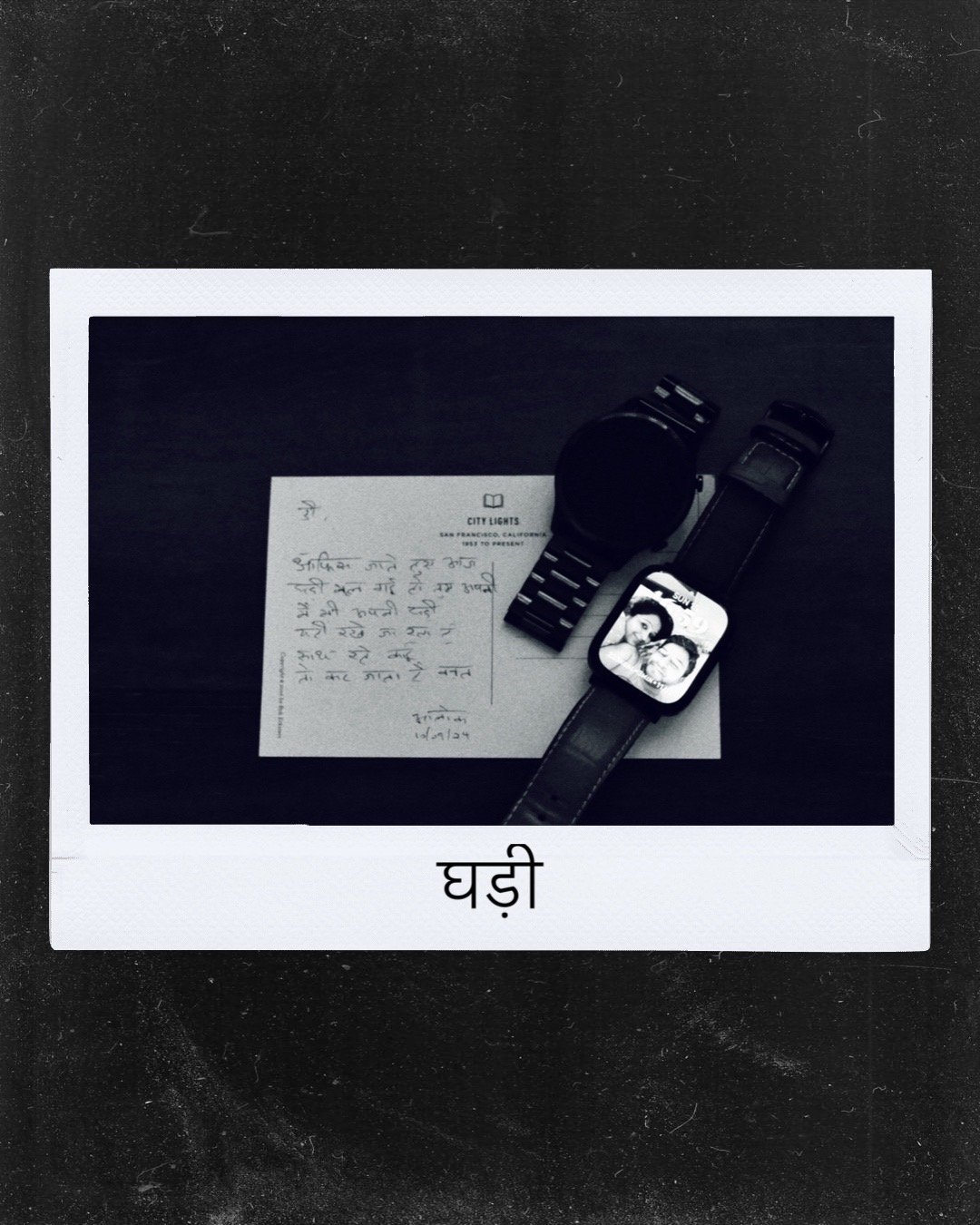
My favourite moments in the day are when Adu and I talk.
On Conversations
My favourite moments in the day are when Adu and I talk. Just talk. About anything and everything under the sun.
A few nights ago, we talked about his future wife—where she might be right now, whether she’s been born yet, and if she hasn’t, what she would be doing in her pre-Adu’s-wife life. Incarnation comes naturally to us Indians. I had told him about the five-year gap between Dee and me, and since he’s only four-and-a-half, toddler logic suggests there’s a good chance his would-be wife hasn’t been born yet.
One weekend morning, in that hazy state of taking an hour to fully wake up, we debated about the kind of dinosaur we should keep as a pet. Most dinosaurs turned out to be too big or aggressive to keep in our aangan or indoors, so we decided on a cat instead. After further discussing the merits and demerits of cats, it was unanimously decided that fish are the best pets. They stay within a glass box, are colorful, and do not leave smelly messes everywhere.
You know that feeling when you’ve heard someone deeply, intently, and intentionally? I hope you do. It is so difficult for adults to peel off their masks and talk that it feels like a miracle when it happens. I treasure the moments when someone has opened up to me. Rarer, but even more precious, are those when I’ve spoken with abandon and someone else has given me their full attention. (Alcohol may have played a part.) It’s another thing that I can count those moments on my forty-four-year-old fingers.
Some nights, Adu and I talk about death. And life. What does being alive mean, how long we’ll be alive, or what happens after we’re not alive? Sometimes, I try to answer these questions rationally. Other times, I’m both fascinated and devastated by what must be going on in his mind. And sometimes, I simply don’t know how to reply.
What I do know is that forty-four years or so from now, when I’m looking back at the life I lived, I’ll be treasuring these warm summer days and nights when Adu and I used to talk. And I want those moments to be far more than my eighty-eight-year-old fingers could ever count.
-Alok, 20:30, September 06, 2024
Touched by light
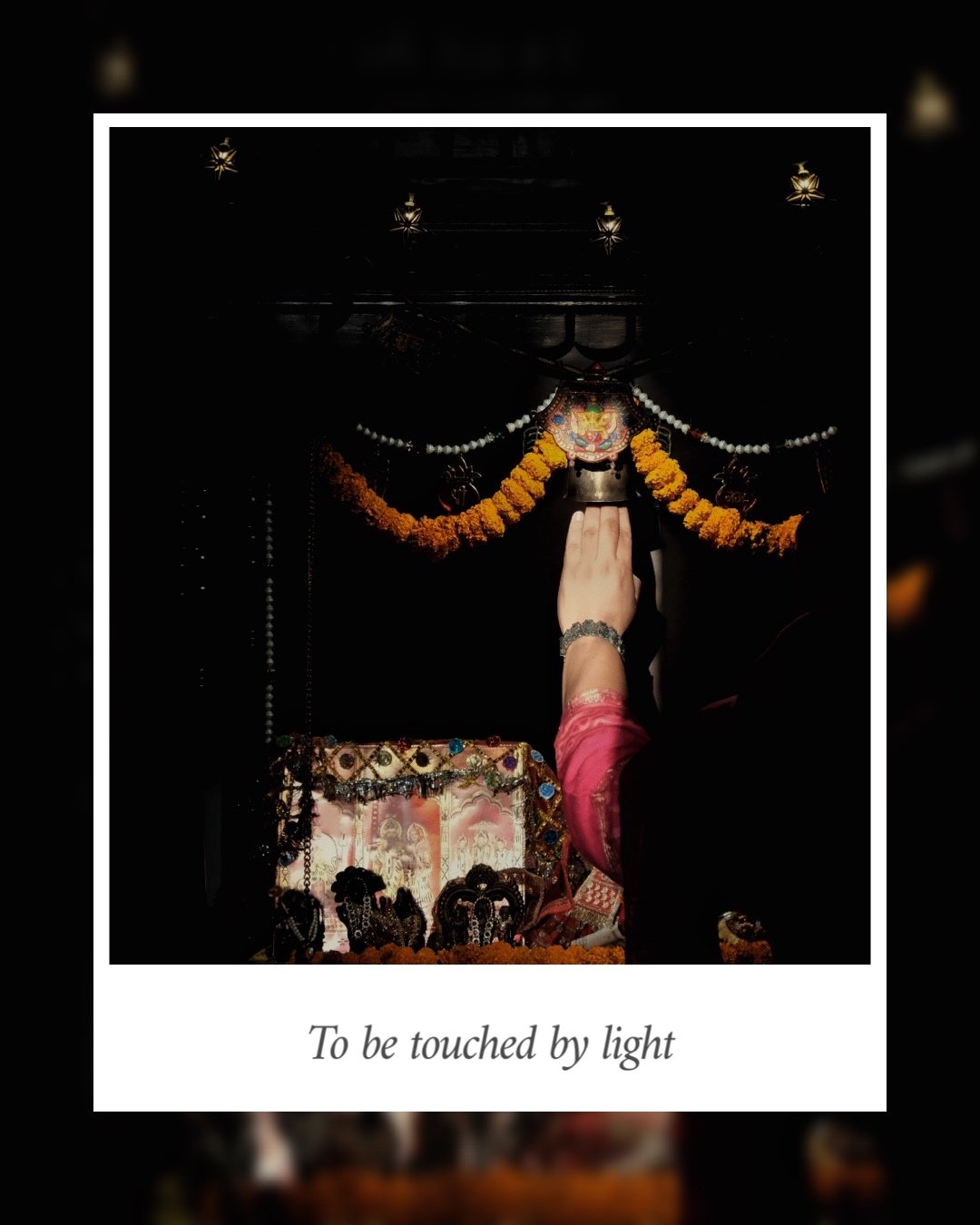
Here’s to light. To hear it slowly shuffling across the room you are in, entering through the window like a stray bird with burning wings and giving everything it touches the gift of life. To feel it on your eyelashes, seeing the soul of the world with your eyes closed. To sit under a banyan tree and see it play hide and seek with shadow, its eternal friend. To being with light, as you look back at the years gone by and realize how it has always been about her. Or him, as you wait patiently by his side to open his eyes at the dawn of time. Yes, light can be a person too.
And yes, it can be you, too.
To be someone’s light. To see their eyes light up at your sight. Knowing that even after the shadow has consumed you, some part of your light will stay alive in them.
To be touched by light, to be alive, to be immortalized.
-Alok 16/04/24
Nettle & Bone - a fairytale with horror, humour, and heart
"Nettle & Bone" by T. Kingfisher intricately blends horror, humour, and fairy tale elements to tell the story of Marra, the third princess who embarks on a quest to save her sister from a dire marriage. Assembling an unlikely alliance of a gravewitch and her demon chicken, a dog of bones, a disgraced knight, and a fairy godmother, Marra confronts her challenges with a unique blend of determination and whimsy.

The journey is fraught with magical obstacles and dark forces, but Kingfisher masterfully balances these with moments of light-hearted humor, ensuring the narrative remains accessible and engaging. Through her journey, Marra not only seeks to change her sister's fate but also discovers her own strength and the true meaning of bravery. The book’s rich storytelling, characterized by its clever use of horror to accentuate the stakes and humor to lighten the mood, makes "Nettle & Bone" a memorable exploration of heroism, family, and the power of persistence.
-Alok, 11/03/24