On Looking Again #2: What the Photograph Kept
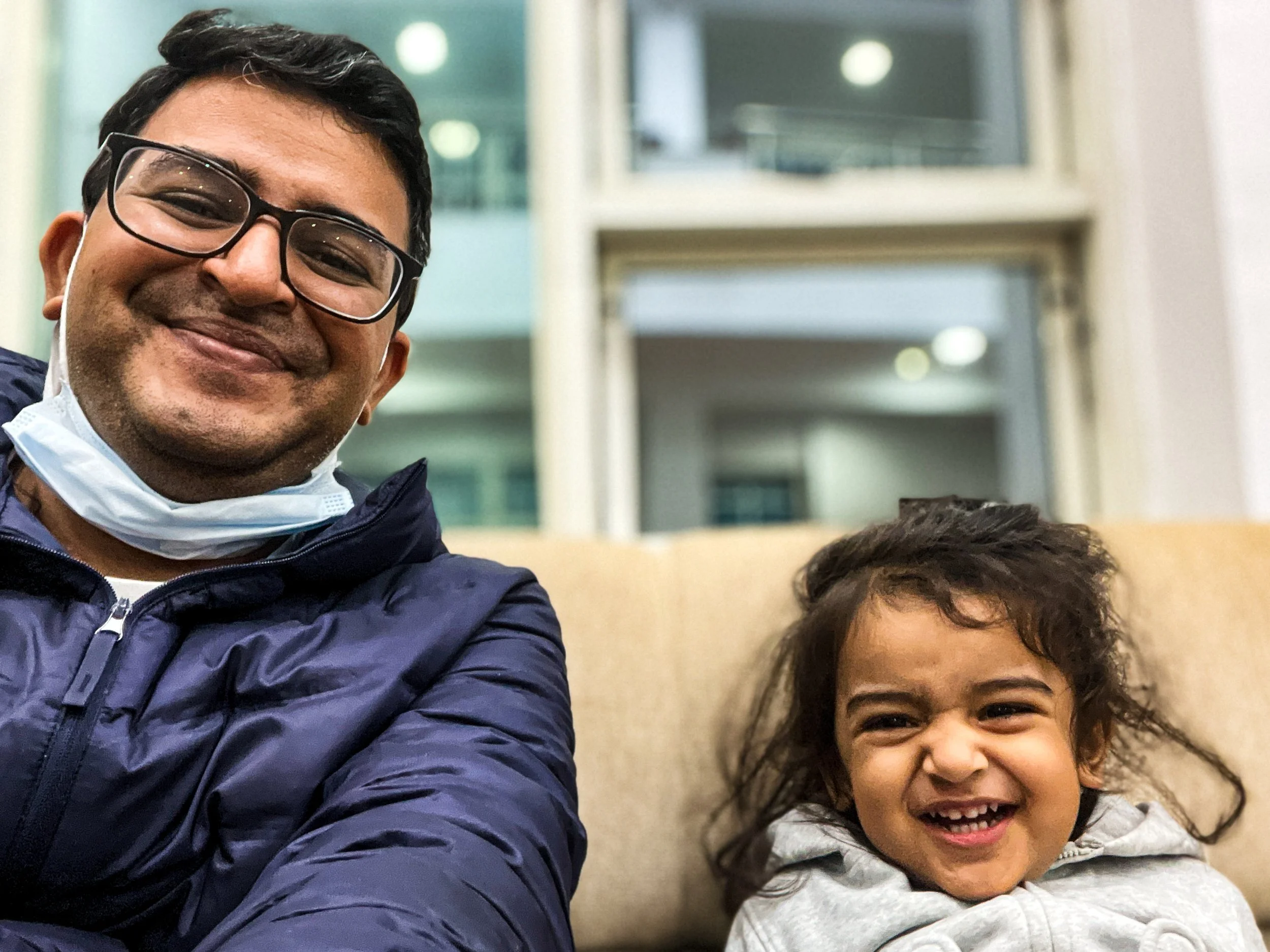
I don’t remember this moment.
Not really.
I know where we are. A guest house in Jaipur. On a trip with the extended family. December 2021. We are waiting in the reception area of a guest house for the rest of the family to come down. Dee is somewhere upstairs. We are waiting to go sightseeing.
Adu is not yet two.
That’s about all I know.
What I do have is this photograph.
For a few moments, it seems, we were the only two people in the world.
I don’t remember what made him laugh. I don’t remember what we talked about, if we talked at all. The photograph has kept none of that.
What it has kept is the smile.
The complete, reckless abandon of it.
I have looked at this photograph many times over the years. At first, I looked at him. Lately, I find myself looking at the space between us.
At the invisible thread that every parent spends years trying to strengthen and then, somehow, learning to loosen.
The photograph doesn’t know any of this, of course.
It knows nothing of school admissions, birthday parties, report cards, arguments, arrivals, departures. It knows nothing of the long work of becoming a person.
It only knows that on a winter morning in Jaipur, a little boy laughed and his father laughed back.
Perhaps that is why I keep taking photographs.
Not because they stop time.
They don’t.
But because every now and then, they return a small piece of it.
Long after the moment itself has gone where all moments go.
On Looking Again #1: What I Thought Was Missing
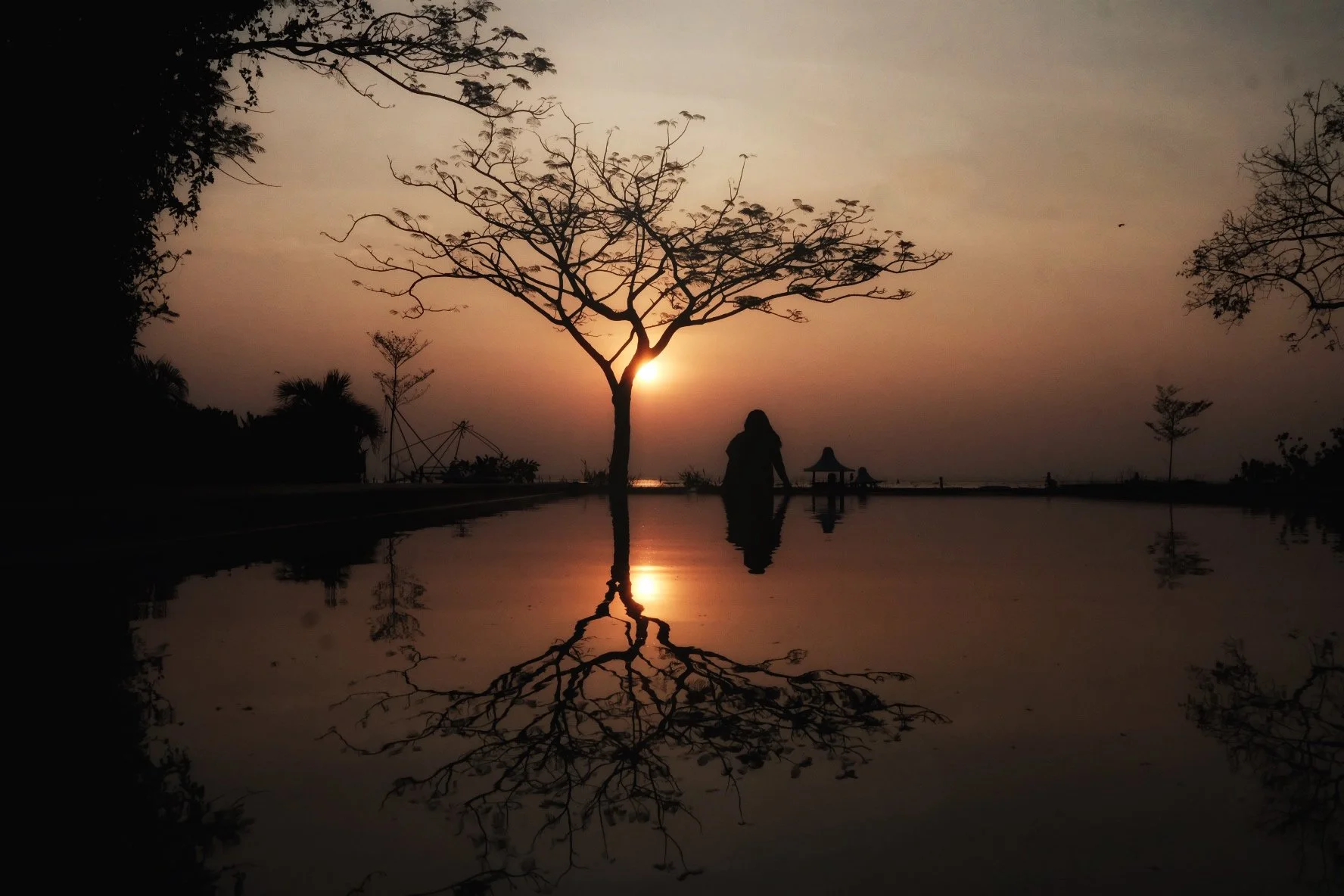
The photographs are better than I remember.
That’s the first thing I notice.
For years, I carried around the memory of being disappointed by that morning. Dee and I had slipped out of our resort room in Kerala before sunrise, leaving Adu asleep, and walked towards the pool with my camera. I must have taken a hundred photographs, but this set was special. Dee sat by the pool while the world slowly emerged from the darkness. The light arrived exactly as it was supposed to. The reflections arrived. The stillness arrived.
Out of the hundred odd photographs, I remember liking very few of them.
Looking at this picture now, I find myself wondering what exactly I thought was missing.
Memory is strange that way. It preserves the dissatisfaction and discards the evidence.
Later that day, I wandered out of the resort and into the nearby village. I met people whose language I didn’t understand and who didn’t understand mine. We smiled, pointed, managed. I found small temples unmarked on Google maps and tour itineraries, though they were no less beautiful than their more famous cousins. By the time I returned, hot, sweaty and thoroughly lost, I felt richer than I had that morning.
Looking back now, I don’t think I was disappointed with the photographs at all.
I think I was beginning to outgrow a certain way of taking them.
The camera had spent years helping me collect beautiful sights. Around this time, I had begun asking it to help me discover something.
The village walk offered that more readily than the resort ever could.
And yet, years later, it is this photograph that has brought the whole day back.
Not the temples.
Not the lanes.
Not the conversations stitched together with gestures.
This one frame.
Perhaps that’s what photographs do best.
They wait quietly for memory to catch up.
A Thanksgiving thought, thanks to my son
Yesterday, I read a book to my son. It was a beautifully illustrated ebook that we both flipped through on my tablet. The book is about a day in the life of seven different children living in seven different places around the world. Seven names, seven faces, seven countries, seven cities…told in the first person, each child introduces themselves, talks about where they live, what they eat for breakfast, where they play, what their school is like, and many other facets of their daily lives.
I think he enjoyed it, though it became a bit verbose for him from time to time. When I downloaded the book, I had imagined that he would be fascinated by the different cultures, environments, and places shown in the book. However, he wasn’t.
What he noticed most were the things in this order: the ages of different children and how they compared to his older cousins, the fact that one of the children didn’t have to wear a uniform to school, the yellow school bus a child takes (the same as the one in his favorite song), the ice skating another child does, the five cats of another child (he asked me to get a cat for him as well), and the one child whose evening activity was watching television (he made sure that I noticed that other children are also allowed to watch TV).
What he didn’t notice was: The color of the children’s skin, their gender, the fact that some children were rich, and some not so much, whether they lived in a city or a village, in an apartment complex or in a mud hut.
He’s going to be four in a couple of months, and I’m afraid of the day when these differences will start seeping into his consciousness. Perhaps we wouldn’t need our DEI conferences, mandatory corporate trainings, amendments, laws, marches, and fights if we all kept our four-year-old selves alive within us.
Thank you, dear Adwitiya, for letting me look at the world through your eyes. It definitely looks like a much ‘equal’ place.
Wishing everyone a Thanksgiving filled with warmth and reflection.